
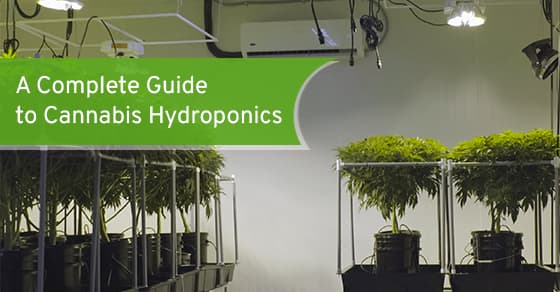
Many die-hard fans of hydroponic cannabis growing wouldn’t swap it for any other growing method. There are plenty of pros to hydroponics. The main benefit is the speed of growth.
Very few growth methods can claim to be faster. Hydroponically grown cannabis grows larger and quicker than any other growing method and perhaps 30%-50% faster than soil. Other benefits include a more sterile grow room without dirt or pests to worry about.
Hydroponics also eliminates the need to dispose of large quantities of soil or coco fibre after growth. Due to the fact that the water is constantly recirculated and reused, you may find your overall water usage levels are lower than they might be for soil growth.
Perhaps the biggest benefit for the specialized hydroponic cannabis grower is the enjoyment and control over various aspects of plant growth compared to other growing methods. Many people see hydroponics as the future of human agricultural food farming.
Understanding Hydroponics
With the hydroponics growing method, the nutrients are dissolved in water. This makes them much more accessible for the roots. Hydroponics involves growing cannabis roots in an oxygen- and nutrient-rich aqueous solution. It’s an ideal recipe for rapid growth.
Needless to say, there is a technical price to pay for such growth benefits. As well as knowing the best nutrients for hydroponic cannabis, you also need a special touch with the nutrient application. Knowing how to keep your plants in the precise nutrient-sweet spot is critical for successful growth.
It is essential to avoid any over/underfeeding and always check the nutrient feeds for your plant requirements at every stage of growth.
The consistent monitoring of the plants is why hydroponics is often avoided by novice growers. The technical complexity can be a big deterrent to many beginners until they have grasped the basics of general cannabis cultivation.
Understanding your pH and EC meters is necessary for controlling and measuring the hydroponic nutrient solution. You will also have to calibrate regularly and have spares just in case one of your meters starts to inevitably fail. Remember, with hydroponics, if you set pH or EC incorrectly, you can damage the entire crop irreversibly.
Some growers dislike the extra equipment required for hydroponics. As opposed to a simple soil growth, a hydroponic system will require extra timers, a potentially noisy air pump, and a water pump (or chiller). However, when used correctly, the best hydroponic systems for cannabis have the capacity to produce explosive growth. Pay attention to the conditions/nutrients, though, or you can destroy your crop just as quickly.
Substrate-Based Hydroponic Systems
Drip-Irrigation Systems
In drip-irrigation systems, nutrient solutions are automatically fed into irrigation lines using a fertilizer injector drawing from concentrated fertilizer tanks or pumps, which pull from reservoirs of pre-mixed solutions.
Solenoids, PVC pipes, poly tubing, manifolds, and garden hoses are often used to deliver the solution to the growing table or planting row. Specialized irrigation parts deploy the solution to the containers through the distribution tubing and drip emitters or sprayers.
Computers or timers that monitor a weight scale, soil moisture sensor, or environmental parameters, such as accumulated light, can trigger irrigation. Plants will grow in pots, grow slabs, or black and white grow bags. Substrates generally consist of peat, coir, rock wool, vermiculite, perlite, bark, wood fibre, or clay pellets.
Ebb-and-Flow Systems (or Flood and Drain)
It is common to use an ebb-and-flow method (also called flood tables) in cannabis vegetative rooms, even though flowering rooms have drippers. This is because the density of vegetative plants can avert the drippers.
Nutrient-based solutions fill the table at a defined level and interval, where they drain back into a reservoir for treatment and reuse.
It is possible to achieve a more uniformly moist substrate through ebb-and-flow irrigation, as the substrate absorbs the liquid upward through capillary action, thereby eliminating dry spots between drip emitters.
These systems have fewer connections and parts than drip systems and are generally easier to maintain and observe. Correct levelling is required to fill the table evenly while still allowing for a small slope toward the drain. The longer the table, the more this step becomes important.
Capillary Mats (Soil or Substrates)
Capillary mats are designed for soil or media-based growing systems to water the plants from the roots up. Traditionally, they retain water and hold it at the plant’s base. In a capillary mat system, the substrate or soil containers sit on an absorbent mat, typically kept moist by thin-walled distribution tubing with holes.
The mats range from simple felt rolls to multi-layer specialized products. The substrate or soil “wicks up” the nutrient solution through the holes in the bottom of the containers.
This is a simplified system with fewer parts and fittings than drip irrigation and without the balancing needed for ebb-and-flow systems. Tables can be modified using a plastic liner under the capillary mat.
It’s very useful in an environment with high plant densities or for plants with a constant water demand due to small container volumes. The mats can work on surfaces that aren’t completely level, and they can move water evenly on floors that have up to a 5% slope.
The mats also compensate for small dips in the underlying surface to prevent pooling. Capillary mats work with a variety of containers, including fabric pots, poly black and white grow bags, and hard-sided plastic pots.
Improve Your Grow With Hydroponics
Many who have taken the leap into hydroponics perfect the craft of the operation and never look back. The ability to grow larger plants, while enjoying increased yields with quicker grow cycles are all highly desirable benefits.
If you have already grasped the basics of cannabis cultivation, then making the transition to growing hydroponic cannabis should not be difficult. Our advice to anyone thinking about hydroponic cannabis growing is to assess a few of the different systems and find what best suits your situation, space, skills, and time.
Once you are settled into the daily routine of checking pH and EC readings and calibrating your meters, hydroponics-grown cannabis can offer a hugely enjoyable growing experience. This includes the joy of seeing the unsurpassed speed and maturing of your plants.
At Polysprout, our black and white grow bags are versatile, durable, and perfect for hydroponic applications. Speak to our team today to learn more about the Polysprout products available to protect your agricultural harvest and grow your yield.